Seat tube angle as the tell
The clearest way to identify relaxed, feet-forward geometry is the seat tube leaning several degrees slacker than a hybrid's. It places the cranks ahead of the hips so a low saddle still gives usable leg extension.
Upright comfort-oriented bicycles for short everyday trips: how they differ from other bike types, how to fit and equip one, and what ownership costs over a few years
Swept bars and a feet-forward seat tube are a set of engineering choices, not a look, and trip length, grade and load decide whether they pay you back.
The clearest way to identify relaxed, feet-forward geometry is the seat tube leaning several degrees slacker than a hybrid's. It places the cranks ahead of the hips so a low saddle still gives usable leg extension.
Bars swept back toward the rider can shorten effective reach by several inches compared with a flat bar of the same width. That is why an upright bike often fits a rider who found a hybrid too stretched out.
Below roughly two miles on flat ground, comfort and convenience matter more than efficiency, and the upright position loses almost nothing. Past five miles the pedaling leverage of a hybrid position starts returning measurable time and effort.
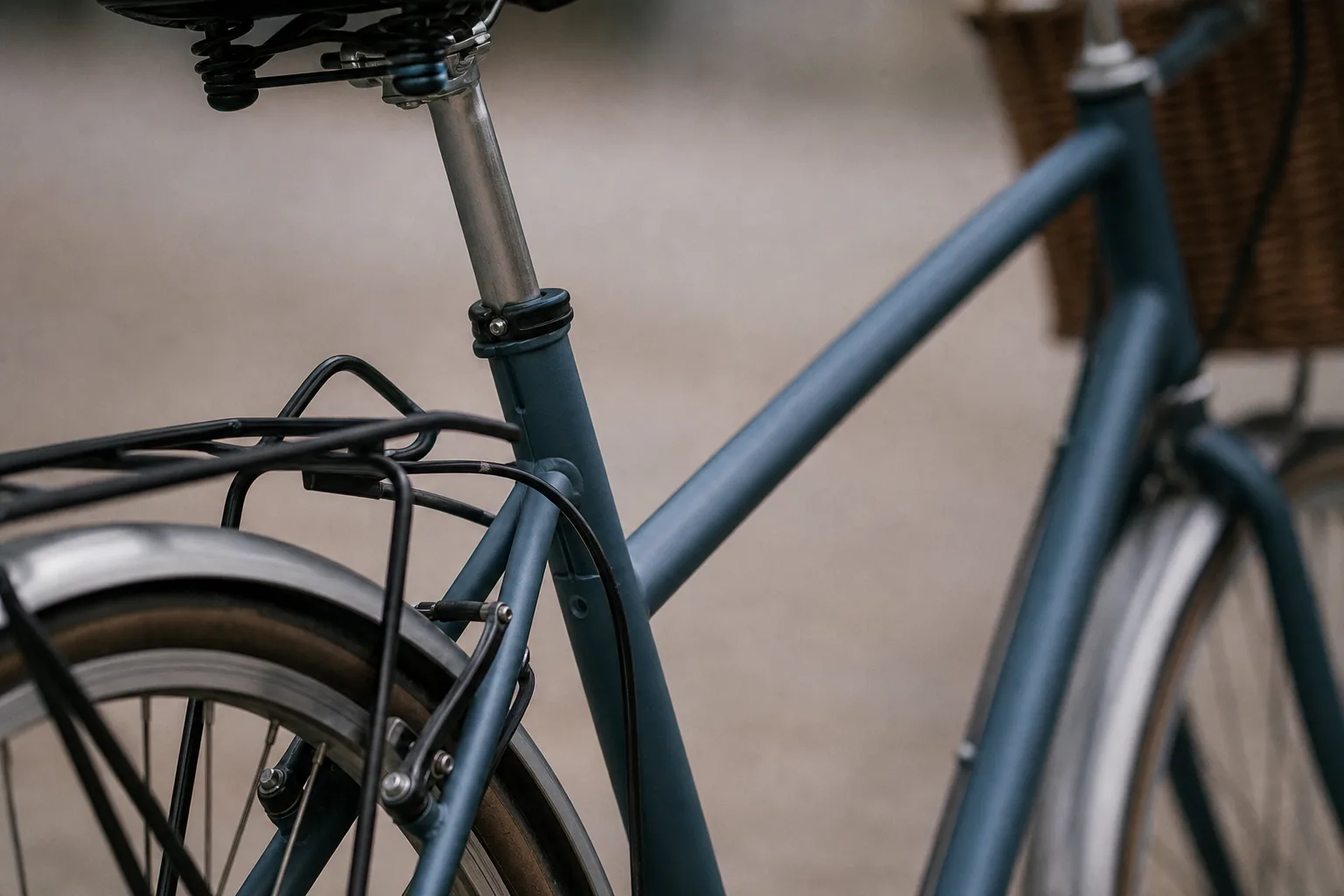
Upright bikes for errands under three miles, covering fit, gearing choices and what a few years of ownership adds up to
Weight difference in practice
A neighbor bought a 26-inch steel single-speed in the spring of 2021 for a trip she made four or five times a week: 1.3 miles to a grocery store, one signalized crossing, a return leg with maybe fifteen pounds in a rear basket. The bike had a laid-back seat tube that put the cranks well ahead of her hips, bars swept back close to sixty degrees, and a saddle wide enough that she never wore padded shorts. For that errand it was close to perfect. Two blocks of her street run uphill at what a phone inclinometer read as roughly six percent, and she walked those two blocks for a year before anyone suggested a hub gear.
What people call cruiser styling is really three measurable decisions working together. The seat tube leans back, often several degrees slacker than a hybrid's, so the pedals sit forward of the saddle and a rider with a low saddle can still get most of a leg extension while touching the ground at stops. The bars sweep toward the rider, which shortens effective reach by inches and rotates the wrists into a neutral grip. The wheelbase grows, and the bike tracks straight with a hand off the bars. Every one of those choices buys comfort at low speed and spends something at higher effort.
What it spends is leverage. Sitting upright with the cranks forward, you cannot get over the pedals to push a big gear, and you cannot pull against the bars the way a road position lets you. On flat ground below about twelve miles an hour that costs almost nothing. On a sustained grade it costs a lot, which is why the honest question is never whether you like how the bike looks but how many minutes of climbing your regular route contains. Storefront listings for Cruiser Bikes group frames that share this geometry regardless of paint, and reading the seat tube angle tells you more than the model name does.
A hybrid moves the saddle back over the bottom bracket, raises the gear range, and drops maybe six to ten pounds off a comparable steel cruiser. That combination starts paying at around three miles and pays steadily after five, because the rider's weight is doing useful work against the pedals instead of pressing straight down into a wide saddle. Road geometry goes further and asks for flexibility most people riding a mile to a coffee shop have no reason to develop. Neither bike is better in the abstract. They are simply tuned for a longer, faster, harder trip than the one most upright frames are built around.
Load changes the math a second time. A rear rack on a long-wheelbase upright frame carries groceries beautifully because the weight sits low and behind a wheel that is already tracking straight, and the bike stays stable one-handed at walking speed. Ask the same frame to carry forty pounds up a grade and the missing leverage shows immediately. The Consumer Product Safety Commission is responsible for the federal requirements that apply to bicycles sold in the United States, including reflectors and braking performance, but nothing in those rules tells you whether a given frame suits your hill. Only the route does.
The purchase price is the smallest number in the decision. Buying an upright bike for a route it does not suit tends to produce a sequence of purchases: a wider-range rear cog or an internally geared wheel, a rack when the basket proves too small, a saddle when the stock one turns out to be sprung for a rider fifty pounds heavier. Each of those is a reasonable expense on its own, and together they can approach a meaningful fraction of what the bike cost. The neighbor's fix, an internally geared rear wheel built up with the original rim, ran a bit under a third of the bike's price installed, and solved the hill outright.
Going the other direction costs differently. A road or performance hybrid bought for short errands rarely gets ridden, because the rider does not want to change clothes for a nine-minute trip, and the resale market for a lightly used aluminum hybrid is unforgiving in most cities. The bike that gets ridden five times a week is the one whose real cost per trip falls toward nothing over three or four years. The bike hanging in the garage has a cost per trip that only climbs, no matter how good the components on it happen to be.
Measure the trip you actually make most often, not the one you imagine making next summer. Under about two miles, with grades you would not notice walking, and loads under twenty pounds, the upright frame wins on the things that determine whether a bike gets used: no special shoes, no changed clothes, feet down at every light, a view over parked cars. Between two and five miles it depends on the hills, and gearing usually settles it. Past five miles, or on anything with a sustained climb, a hybrid position starts returning real minutes and real effort per ride.
Write down the number of stop signs too. A route with a stop every block rewards a bike you can straddle without dismounting, and that single ergonomic fact explains more upright bike purchases than any amount of styling ever has. The frame is doing exactly what it was drawn to do.
A bike ridden five times a week drives its cost per trip toward nothing within a few years. One that hangs unused only gets more expensive per ride, whatever it cost.
Routes with frequent stops favor a frame you can straddle without dismounting, foot flat on the pavement. Count the intersections on your regular trip before choosing geometry.
The clearest way to identify relaxed, feet-forward geometry is the seat tube leaning several degrees slacker than a hybrid's. It places the cranks ahead of the hips so a low saddle still gives usable leg extension.